My work deals with the threat to both the polar regions and the planet as whole from the collapse of key parts of the Earth system. My work is controversial, but the research is highly cited and respected.
As a glaciologist I know that Earth’s frozen places will suffer irreversible thaw under all scenarios of climate change projected for the future.
The melting of ice stored on the polar ice sheets for millennia to rising global sea levels; the change from frozen seas to open ocean; the permafrost thawing to release vast volumes of greenhouse gases, has already begun.
I firmly believe we have a moral duty to explore any other tools that science can muster – in addition to the obvious imperative to decarbonize as fast as possible – far, far faster than we are doing now. Change is happening. Let’s make it as graceful as we can.
But treating the symptoms of climate change is hugely controversial in academic circles. Many have devoted long careers to mitigate, mitigate and mitigate as the only options. Others think the old ways of prohibiting actions will be enough to save nature. It won’t.
Hands Off no longer works, we need to get our Hands On.
So what’s wrong with treating symptoms? Let’s work to compassionately reduce harm from climate change. Let’s work with Arctic Peoples to find a sustainable pathway to the future that benefits the people who live in the Arctic as well as the rest of the world.
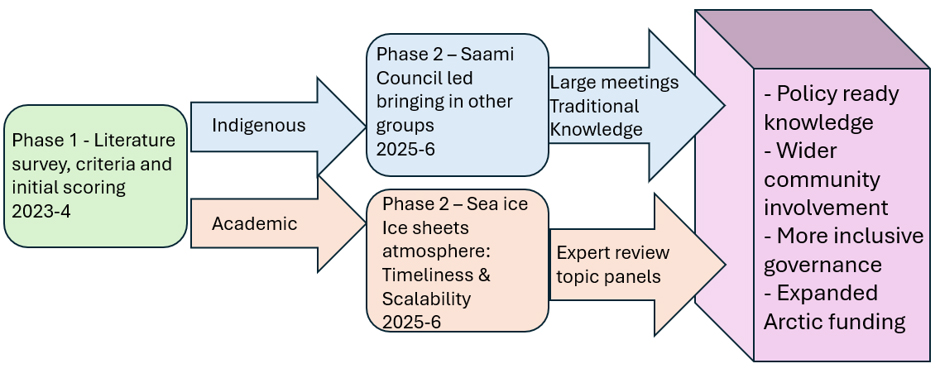
This view led to my deep involvement with the University of the Arctic (UArctic) review of potential ways that can be explored from a western scientific, and an indigenous knowledge perspective. I also lead the UArctic network on Frozen Arctic Conservation and UArctic initiative on tipping point actions.
Arguably the greatest threat from climate change comes from rising sea levels. Destabilization of the Thwaites and Pine Island glaciers may raise global sea-levels by 1 m, triggering a wider collapse of the West Antarctic Ice Sheet displacing one billion people, and costing perhaps $700 billion per year in flood damages. Flooding cities like London, submerging island states, inundating huge areas of densely populated agricultural land, and threatening 450 nuclear power plants.
One promising idea to avoid ice sheet collapse is seabed curtains which is currently supported by private funding and partners University of Lapland with institutions like New York University, Norwegian Institute for Water Research and UArctic, with a highly respected set of advisors from academia, media and activism.
The global south bears the brunt of on-going climate damage, has least financial resources to cope with catastrophic impacts, and is underrepresented academically and politically from knowledge on climate geoengineering. I work with scientists from the Global South through the Degrees Initiative that funds researchers working on solar geoengineering in 28 countries. I have long-standing research collaborations with scientists from Indonesia, Brazil, Iran, Ivory Coast, and Pakistan among others.
You can read more about the results in my publications.
Comments
to John Moore, Arctic Centre,
University of Lapland, Box 122, FIN 96101 Rovaniemi, Finland